Runtime & Version Resolution
EmbrAIon separates the global launcher version from the framework release pinned by each project.
One launcher, multiple project pins
A project records its framework contract in:
.embraion/project.yaml
A v0.14+ project pin can include the exact published wheel identity and its verified SHA-256 digest:
framework:
  repository: GORYNED/EmbrAIon
  version: 0.16.0
  artifact:
    schema: 1
    source: github-release
    release: v0.16.0
    asset: embraion-0.16.0-py3-none-any.whl
    digest: sha256:<64-lowercase-hex>
The artifact lock is framework-owned. Consumer CI does not need a separate wheel URL, hardcoded checksum variable, or custom checksum parser.
Older version-only manifests remain valid. The next successful embraion update upgrades them automatically and materializes the lock; no manual migration is required.
Ordinary commands locate the nearest project and resolve its pin:
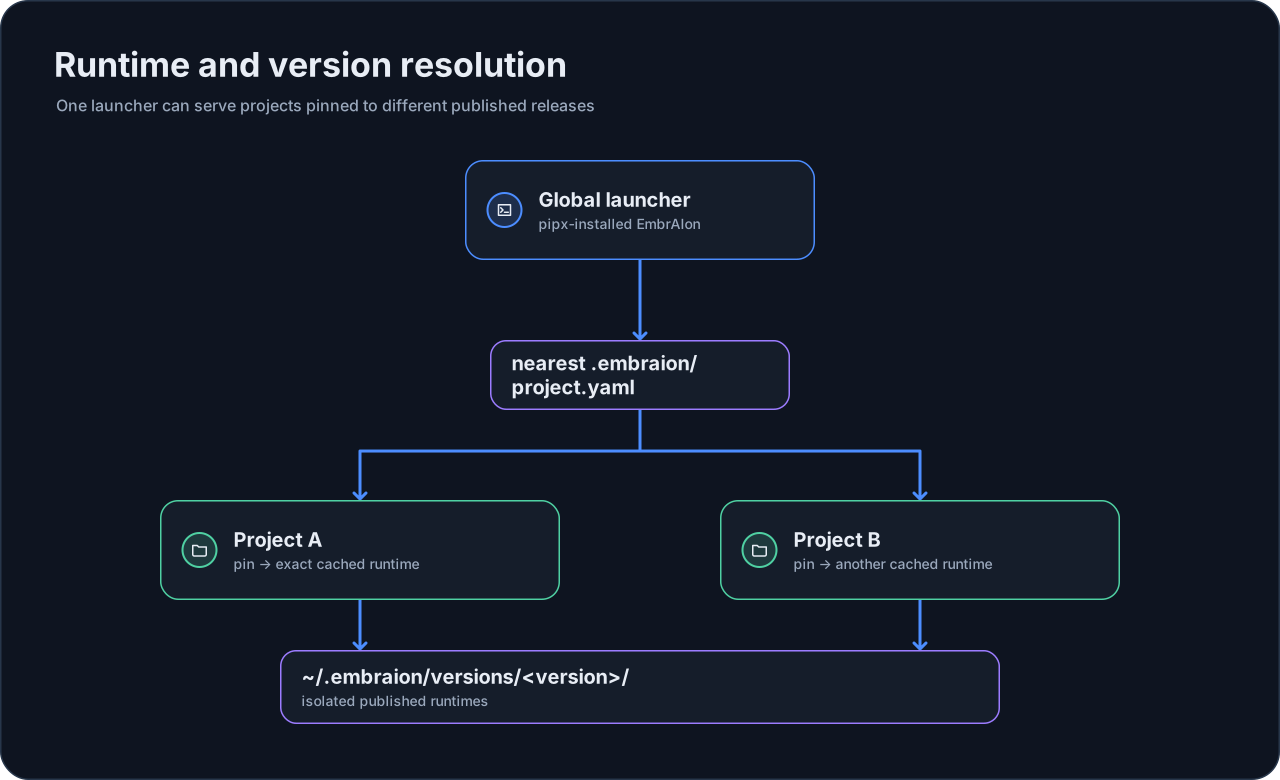
If the pin differs from the launcher version, EmbrAIon installs the exact pinned distribution into an isolated cache:
~/.embraion/versions/<version>/
For locked projects, the runtime resolver downloads the exact release asset from the canonical GitHub release URL, verifies its SHA-256 digest before pip installs it, and records the artifact identity in the runtime marker. A cached runtime is reusable only when its recorded artifact identity and digest match the project lock.
Different repositories can therefore remain on different EmbrAIon releases on the same machine.
On Windows, a long EMBRAION_CACHE_HOME can make paths inside the release wheel exceed the common 260-character installation limit. For a locked release, framework install checks wheel paths before creating or replacing the runtime and reports the required action. Set EMBRAION_CACHE_HOME to a short directory such as C:\EmbrAIonCache and retry. A valid cached runtime is reused without reinstalling it.
Update, verify, install
Upgrade the global launcher first, then update the project:
pipx upgrade embraion
cd MyProject
embraion update
embraion update targets the installed launcher version. Before changing the project pin it resolves the canonical GitHub Release, requires exactly one expected wheel asset, requires GitHub's server-side sha256: digest, validates the release tag / asset name / URL, and validates the candidate project configuration.
The manifest write is the update commit point: framework.version and framework.artifact are replaced together in one atomic YAML write. Missing release metadata, a missing artifact, a malformed digest, or incompatible project configuration fails closed before the pin changes.
To verify the locked release artifact without installing it:
embraion framework verify
To install the exact digest-verified release into the isolated runtime cache:
embraion framework install
Both commands read only the project pin/lock for artifact identity. They do not require consumer-owned checksum logic.
Consumer CI
GitHub Actions workflows can use the reusable setup action instead of their own setup step and pin reader:
steps:
  - uses: actions/checkout@v4
    with:
      fetch-depth: 0  # history for --base-ref
  - uses: GORYNED/EmbrAIon/actions/setup@v<release>
    with:
      python-version: "3.13"  # optional, the default
      project-path: .         # optional, a directory at or below the project root
  - uses: GORYNED/EmbrAIon/actions/check@v<release>
The check action runs embraion framework install for a locked pin and then embraion check, so the workflow carries no project flags: the organization modes, security threshold and scan scope come from the check section of .embraion/policy.yaml (see Check options). It takes project-path (default ., the project root or a directory below it), base-ref, upload-evidence (default false), and evidence-retention-days (default 14). With upload-evidence: "true" it uploads .embraion/state/validation/ of the project root, which it resolves the way embraion check does, as a workflow artifact with a run-unique name, also when a check fails. That directory holds the evidence of the validation profiles that check.validation-profiles runs. It is hidden, so the action uploads hidden files. When no profile ran, the upload step warns that no files were found. The artifact carries the full output of the profile commands, so anything those commands print is stored with the run; keep upload-evidence off for sensitive output and lower evidence-retention-days. Locating the artifact never fails the action. Without base-ref, pull requests compare with origin/<base branch> and pushes use the verified previous commit from the event. Initial pushes, unavailable previous commits, and rewritten histories have no usable base; the action fails only when a selected comparison check requires one. Fetch the needed history in checkout. It expects EmbrAIon to be installed by the setup action first and has no python-version input. embraion check runs every check the project configuration selects; see the CLI reference.
The action sets up Python, reads .embraion/project.yaml with the same reader as embraion framework pin, and installs exactly the pinned release. With an artifact lock it downloads the canonical release wheel and verifies its SHA-256 before pip installs it; without a lock it installs embraion==<version>. It then confirms the installed version. A missing or inexact pin, a mismatched lock, or a digest mismatch fails the step. Outputs: version and digest (empty without a lock).
The action ref selects only the bootstrap code. The installed release always comes from the project pin, so embraion update takes effect without a workflow edit; move the ref only to adopt newer bootstrap behavior. The pin reader runs from the action's own release in an isolated environment with PyYAML only, and project text cannot issue workflow commands to the log. The steps use bash and are written for Linux and macOS runners; Windows runners are not covered. Commands in a locked project still run from the digest-bound runtime cache described above.
Other CI systems can follow the same contract: embraion framework pin prints version= and digest= lines and fails on an inexact pin. embraion enforcement install generates a workflow that uses the action.
Inspect resolution
embraion status
embraion status --json
The status report shows the launcher, project pin, resolved runtime, cache state, and whether the project has an artifact lock and digest.
Cache management
embraion cache list
Dry-run pruning:
embraion cache prune --older-than 90
Apply intentionally:
embraion cache prune --older-than 90 --apply
The active launcher and current project's resolved runtime are protected from age-based pruning.
Moving to a different specific release
Install that launcher version first, then run embraion update from the project. Configuration normalization and artifact-lock generation are owned by the same release contract that will be written.
Development override
EMBRAION_HOME selects an explicit framework checkout for framework development. Automatic version resolution can also be disabled intentionally with EMBRAION_DISABLE_VERSION_RESOLUTION=1.
Resolver-owned EMBRAION_VERSION_RESOLVED, EMBRAION_RESOLVED_VERSION, EMBRAION_RESOLVED_PROJECT, and the resolver's EMBRAION_HOME apply only to the delegated interpreter. Validation and other independent child commands receive a clean environment and resolve their own project. An explicit user development override remains inherited. Cached runtime installation, probes, and delegation also exclude PYTHONPATH so checkout imports cannot replace the locked distribution.
The framework repository is itself an EmbrAIon project. Its pin and artifact lock stay on the latest published stable release while source development advances. From a checkout, use python tools/source.py <command> for source CLI operations and python tools/source.py test unit or test integration for source tests. The runner selects checkout code and data, removes inherited resolver state, and uses the local .venv when present; otherwise the current Python must have the framework dependencies installed. Source CLI commands retain the repository's project overlay and routing. Repository validation profiles and source CI steps use this entry point; installed-package checks outside the checkout continue to use the packaged CLI.
Both test commands accept --jobs N or --jobs auto (the CPU count, at most 4). With more than one job, test modules run in separate worker processes that take modules from a shared queue, largest files first. Each process uses its own temporary directory (TMPDIR, TEMP, and TMP). The command prints one summary per process and a combined total, keeps the failure output, and exits non-zero if any process fails or if the number of tests run differs from the number discovered. Without --jobs, with --jobs 1, and with --jobs auto on a one-CPU machine, the tests run in one process exactly as before. A worker that exits with a non-zero status counts as crashed even if it wrote a result. Modules that cannot share a machine with parallel processes may be named in SEQUENTIAL_MODULES in tools/parallel_tests.py; they then run in the parent process after the parallel phase. The current unit allowlist names test_core, test_sources, test_policy_ceilings, test_config_checks, and test_derived_generated because they scan the checkout while other modules create temporary build files. It also names test_worktree_housekeeping: Windows Git worktree deletion failed in a parallel run and the 57-test module completed in isolation with one skip. The runner executes these modules after the parallel phase.
Isolation audit of the parallel runner, from reading the code and searching the tests for shared state. Tests use no fixed ports (servers bind port 0). Tests that write under build/ use unique temporary directories or mkdir(exist_ok=True). Tests that create projects or checkouts use temporary directories. The CLI tests that start embraion as a subprocess set EMBRAION_CACHE_HOME to a temporary directory or turn version resolution off, so they do not touch the user's runtime cache. Code that reads ~/.codex, ~/.claude, or ~/.agents/skills only reads. One test writes shared state: test_clean_project_bootstrap_and_update in tests/integration/test_reference_projects.py calls update_project in the test process. That installs the runtime for pin 0.8.1 into the real runtime cache (~/.embraion/versions/, changed by EMBRAION_CACHE_HOME) and fills the pip cache. It is the only module that does this, and the unit and integration suites run one after the other, so no two processes write there at the same time. A new test that writes to the runtime cache, the user's home, a fixed path, or a fixed port must set its own location, or be named in SEQUENTIAL_MODULES.