Policy & Protected Paths
.embraion/policy.yaml contains project-owned safety policy.
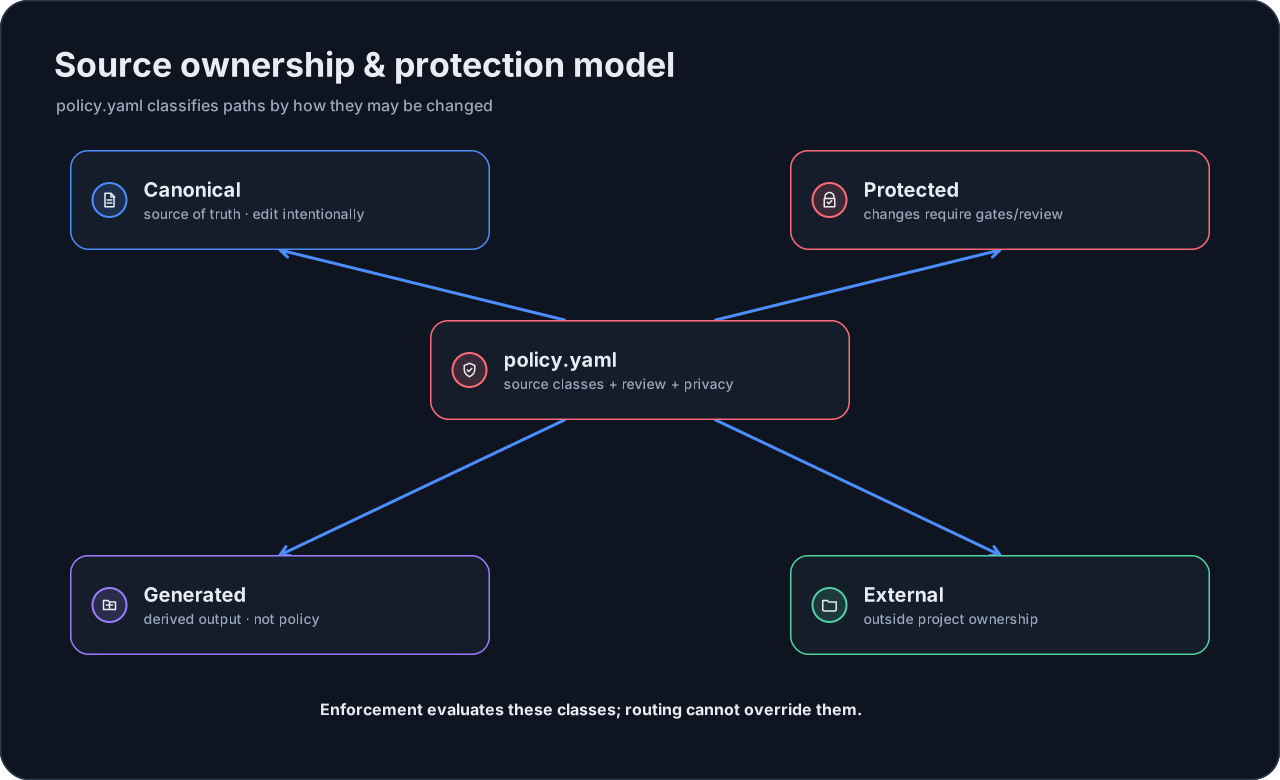
A typical configuration:
sources:
  canonical:
    - src/**
    - knowledge/**
  protected:
    - vendor/**
  generated:
    - build/**
  external:
    - external/**

review:
  substantial-required: true

privacy:
  default-class: PRIVATE

enforcement:
  enabled: false
  validation-profile: affected
  require-review: false
Source classes
canonical
Project-owned source of truth. These are normal authored files.
protected
Paths that ordinary writable work must not mutate. Use this for material that requires a separate approval or ownership path.
Protected-path checks cover modifications, additions where relevant, deletions, rename sources, and dot-prefixed paths such as .github/**.
generated
Build output or other derived files that should not be mistaken for canonical authored source.
Files that embraion install recorded in a projection ledger under .embraion/state/projections also count as generated, so installed host projections need no hand-maintained entries. Explicit entries stay supported and come first. Files that a projection merges into user-owned content, .claude/settings.json and .codex/config.toml in merge mode, are not added. The ledgers are local state: a fresh checkout without them uses only the explicit entries, and security scan --all-files always uses only the explicit entries. embraion policy show --json lists the derived entries under derived-sources.generated, and embraion validate warns when Git ignores a ledger file.
external
Material sourced from outside the project and governed separately from project-owned source.
Review policy
review:
  substantial-required: true
This expresses the project rule that substantial work requires review evidence where the execution contract calls for it.
Privacy default
privacy:
  default-class: PRIVATE
Valid classes are PUBLIC, PRIVATE, and CONFIDENTIAL.
Optional sources gives each stable source ID its data class:
privacy:
  default-class: PRIVATE
  sources:
    PublicDocs: PUBLIC
    App: PRIVATE
    VendorSdk: CONFIDENTIAL
When sources is declared, an execution request may name only listed source IDs, and its data class must be at least the highest class of the sources it names; otherwise the request fails before any provider is selected. Without sources requests are checked as before.
An optional source registry adds a role and a write policy for each ID, and a data-class that can only raise the class declared here.
Model choice cannot widen these boundaries.
Enforcement policy
Enforcement is disabled by default:
enforcement:
  enabled: false
  validation-profile: affected
  require-review: false
The optional protected-sources key selects how protected paths are checked:
enforcement:
  protected-sources: base-tree
name(the default when the key is omitted): match the names of changed files against the protected list of the checked-out policy.base-tree: read the protected list from the merge base and compare protected paths by Git object ID. Any other value fails validation. The stricter mode of the head policy and the merge-base policy wins, so a change cannot turnbase-treeoff once the base has it; the first pull request that enables it relies on the head policy. See Protect sources by Git object identity.
Do not manually flip this block and assume CI is installed. Use the explicit command when you are ready to add the GitHub Actions surface:
embraion enforcement install \
  --surface github-actions \
  --validation-profile affected
See Enforcement for the complete workflow.
Merge mode
merge:
  mode: human-only
The optional merge.mode selects who may merge a pull request under the human merge rule:
human-only(the default whenmergeis omitted): agents stop at a reviewable pull request and a human merges.owner-permission: an agent may merge a pull request only with the owner's explicit permission for that pull request, after the required checks pass on its final head and the independent reviewer confirms that exact head.
Auto-merge is never enabled in either mode. Any other value fails validation and projection. Host installation states the selected mode in one line of the projected Core rules (.claude/rules/embraion-core.md, .github/instructions/embraion-core.instructions.md, and the managed Codex block); run embraion install again after changing it, and projection verify reports the stale line until then.
Policy ceilings
ceilings declares the most a project allows. Deployments, execution bindings, and routing may narrow these limits but never widen them, so a routine YAML edit cannot silently grant a provider more data, access, or sources:
ceilings:
  providers:
    deepseek:
      data-classes: [PUBLIC]
      access-modes: [read-only]
      roles: [research]
      sources: [PublicOfficialUpstream]
    anthropic:
      data-classes: [PUBLIC, PRIVATE]
      access-modes: [read-only]
      roles: [independent-review]
      binding-required-billing-modes: [api]
  data-classes:
    CONFIDENTIAL: {providers: [openai]}
  sources:
    VendorSdk: {providers: [openai]}
  task-classes:
    protected-decision: {route-class: critical}
  critical:
    justifications: [security-critical, migration-data-loss, recovery-integrity, exceptional-systemic-risk]
providers.<provider>limits every enabled deployment of that provider. A listed dimension that the deployment leaves out counts as unrestricted and fails.sourceslimits the deployment's execution bindingsourceIds. Whendata-classesorrolesare limited, the binding must listtaskClasses, and every task class that the binding or routing sends to the deployment must stay within the limit.binding-required-billing-modesrequires an execution binding for those billing modes.- Host overrides under
overrides.<host>in.embraion/routing.yamlare checked with their fallbacks. Every request an override matches must stay within the ceiling. Routing refuses a data class that the selected deployment'scapabilities.data-classesdoes not list, so a deployment whose data classes are within the ceiling bounds the data class of every request. Aroutesoverride also matches requests with any role or none, so selecting a ceilinged deployment isceiling-unboundedwhen that provider limitsroles, or limitsdata-classesbeyond what the deployment's capabilities bound. Arolesorroute-rolesoverride must name a role within therolesceiling (ceiling-role), and it isceiling-unboundedwhen the provider limitsdata-classesand the deployment's capabilities do not keep them within it.task-classesoverrides are checked like routing task classes. data-classes.<class>.providersallows that data class only for these providers. A deployment without adata-classeslist counts as allowing every class.sources.<sourceId>.providersallows an execution source only for these providers.task-classes.<id>pins the route class, role, or data class of a routing task class so it cannot be lowered.critical.justificationsturns critical-route justification into a closed set.embraion route,dispatch, andexecutethen accept only<reason>or<reason>: detailswith a listed reason.
Check the ceilings explicitly or as part of embraion validate inside the project:
embraion policy check
embraion policy check --json
embraion validate
Each finding names the file location and the ceiling it exceeds. Projects without ceilings keep the previous behavior.
Projection root checks
Codex merge mode keeps user-owned content in .codex/config.toml. The optional projection section decides how embraion projection verify --config-mode merge treats that content:
projection:
  codex:
    strict-root: true
    forbidden-root-keys:
      - profiles.*.model
    allowed-root-keys:
      - mcp_servers
forbidden-root-keysadds dotted key patterns to the Core defaultsmodel,model_reasoning_effort, andagents.default_subagent_*. A project can extend the defaults but cannot remove them.allowed-root-keysis an optional allowlist of top-level keys.developer_instructionsandagentsare always allowed because EmbrAIon manages blocks inside them.- Root
developer_instructionstext outside the managed orchestration block is always reported. strict-root: trueturns these findings into verification failures, the same as--strict-root. Without it they are warnings and verification still depends only on projection drift.
components declares which installed projection components embraion check verifies for each host; a host without components is not verified there. Codex also takes config-mode (replace, the default, or merge) for its config component:
projection:
  codex:
    components: [config, agents, skills]
    config-mode: merge
  copilot:
    components: [agents, skills]
  claude-code:
    components: [agents, skills, scoped-agents, hooks]
Declared Claude Code scoped-agents and hooks also make embraion check require them through claude-native status --require.
Check options
The optional check section chooses what embraion check runs, so CI carries no project flags:
check:
  organization: [full, compare]
  fail-on: medium
  all-files: true
  validation-profiles: [affected]
organizationlists the organization-check modes.fullaudits the whole structure.comparecompares against--base-ref, so only new findings, moves and GUID changes fail, and it is reported asNOT RUNwithout a base ref. Omitted,embraion checkrunsfullwithout--base-refandcomparewith it. Declared modes appear asorganization-fullandorganization-compareand apply only when.embraion/organization.yamlexists.fail-onis the lowest security finding severity that fails the check (info,low,medium,highorcritical); the default ishigh.all-filesalso scans every other text file for private keys, tokens and machine paths, as--all-filesdoes insecurity scan; the default isfalse.validation-profileslists project validation profiles from.embraion/validation.yaml.embraion checkruns each one after all other checks, as the stepvalidation-<profile>, the same wayembraion validation run <profile>does, and records the same evidence under.embraion/state/validation/. A step passes only when the profile result ispassed. Failed and timed-out profiles fail it. A declared profile must prove something, so an unknown profile, an empty profile (skipped), and a profile with a required parameter that has no default also fail it. Omitted, no profile runs.
The --fail-on flag overrides fail-on, and --all-files turns the full scan on; the other values have no flag. A project without the section behaves as before. Pass a base-ref (or declare full) for runs without a pull request base, such as a push, where compare is not run. Only a release that contains the section accepts it, so move the project pin to such a release first.
Inspect the effective policy
embraion policy show
embraion policy show --json
For a committed policy, embraion policy show --ref <git-ref> --json returns the resolved
commit and its schema-checked policy object. It reads Git objects, so uncommitted edits and
local projection ledgers cannot change the result. Missing or ambiguous committed policy
fails closed. A consumer can use --path <project-root> to inspect another checkout.
Invalid project configuration fails closed instead of being interpreted heuristically.