How EmbrAIon Works
In plain English
You still type a normal request into Codex, Copilot, or Claude Code. The host already has generated native files that point it at the repository's EmbrAIon contract. EmbrAIon does not intercept the chat; it gives the host shared project rules and provides real commands for validation, enforcement, and optional provider execution.
Bootstrap and task execution
First ask “Configure EmbrAIon for this project.” Project Bootstrap discovers the repository and configures its canonical contract. Subsequent work follows this flow:
User prompt → Lead → specialist selection
  → classification of each assignment → project routing
  → host capability check → native model/effort and execution
  → validation/review → Lead integration
Role != Route != Model. Host-default supports delegation; explicit routing applies only through verified capabilities.
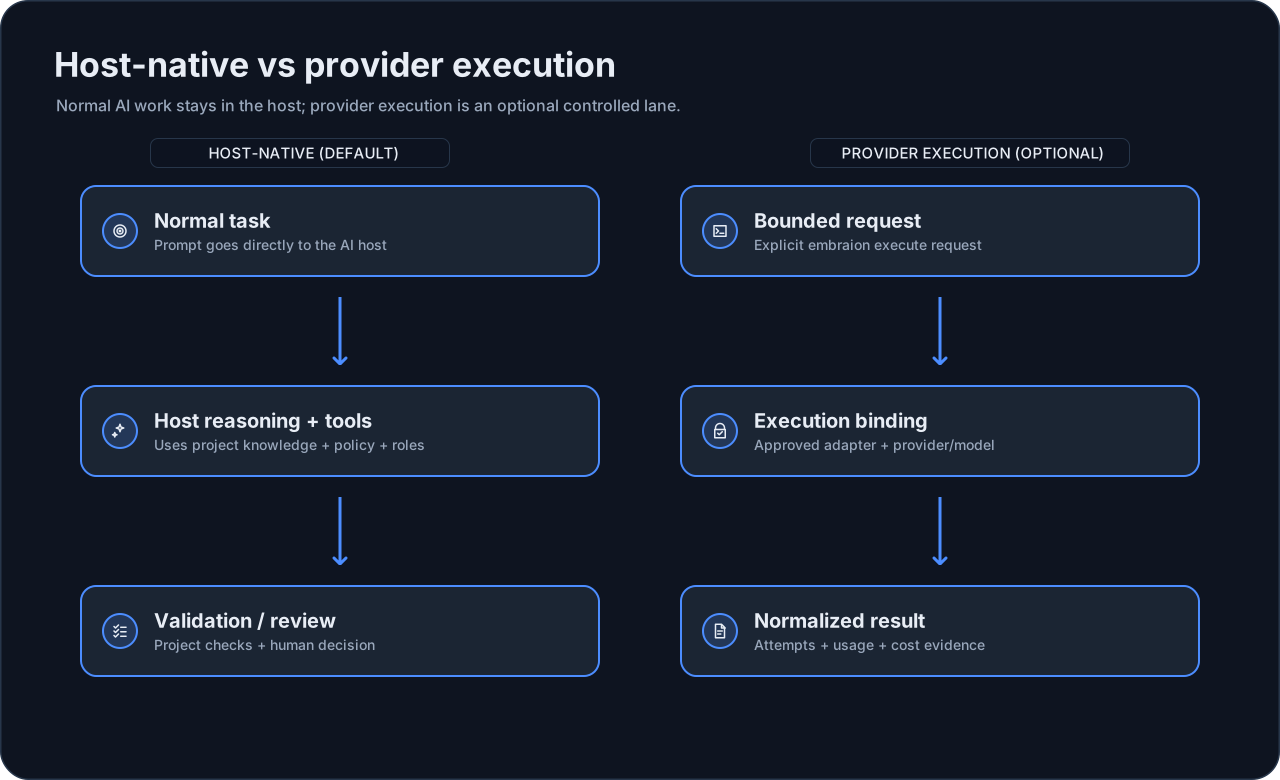
The simple path: host-native work
This is the path most projects use every day.
you ask for an engineering outcome
          ↓
Codex / Copilot / Claude Code
          ↓
generated host-native EmbrAIon files
          +
project .embraion/ settings
          ↓
AI reasoning / edits / tools
          ↓
project validation
          ↓
review / evidence / human merge
For the first useful setup, focus on:
- Knowledge — what the AI should know.
- Policy — what paths/rules it should respect.
- Validation — what commands prove the result works.
Routing, custom deployments, provider execution, pricing, and enforcement can stay at defaults until needed.
What is guidance vs what really executes?
For engineers
Generated agents and skills are host-native instructions. They guide the AI client. They are not the same thing as executable framework checks.
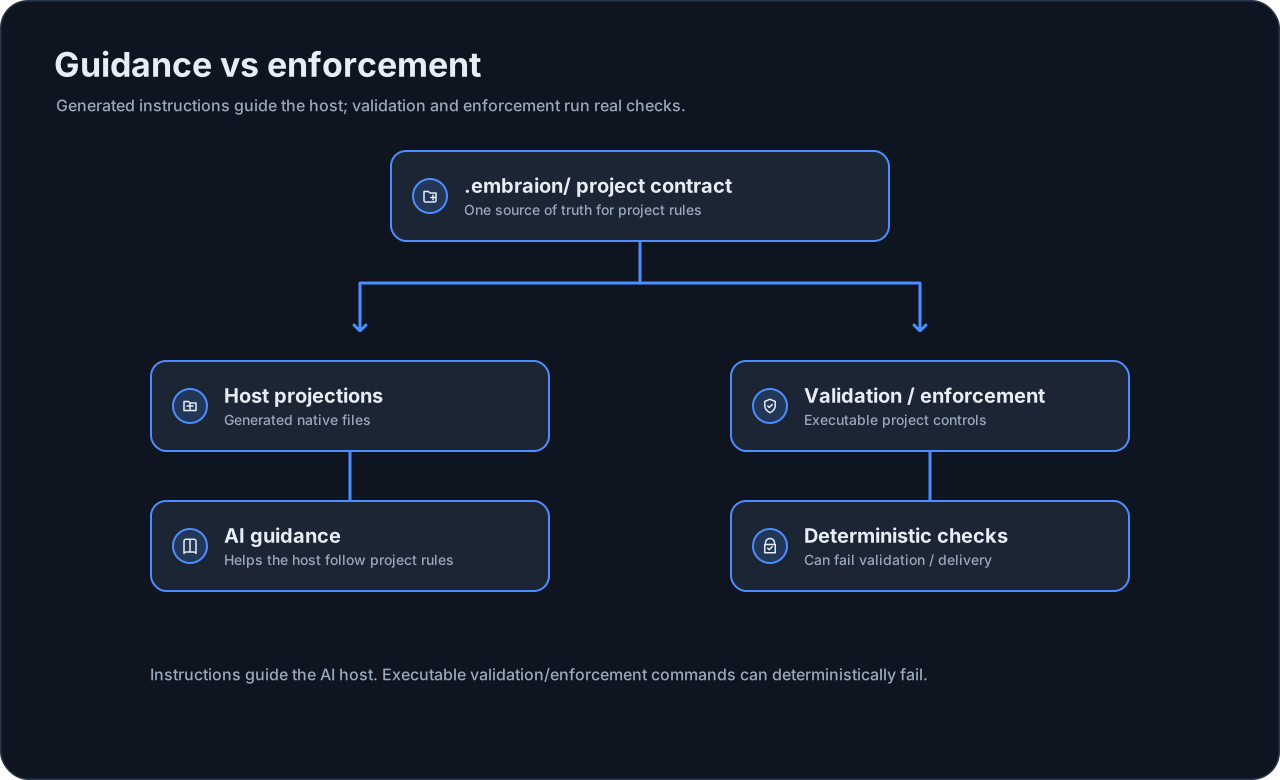
embraion validation run affected
embraion enforcement check --base-ref origin/main
Those commands run real deterministic checks.
For the complete ownership model, see Engineering Model Deep Dive.
The advanced path: provider execution
Some projects also want a controlled external/API lane.
bounded execution request
      ↓
project deployment + execution binding
      ↓
EmbrAIon provider-neutral runtime
      ↓
approved provider/model
      ↓
normalized result / attempts / usage / cost
This is optional. Ordinary Codex/Copilot/Claude conversations do not pass through it.
Conversational configuration
You can say:
Mark
vendor/**protected, register our architecture document, and add the integration test command to affected validation.
The AI host should update the canonical project files for those concerns.
You do not need to memorize YAML
The point of .embraion/ is not to make humans remember more filenames. It gives the repository and the AI one authority per concern.