Configure EmbrAIon for Your Project
After embraion init, your repository owns a small configuration surface under .embraion/.
The easiest way to understand it is by question, not by schema:
| Question | Canonical file |
|---|---|
| What project is this and which EmbrAIon release does it use? | project.yaml |
| What facts and architecture should the AI know? | knowledge.yaml |
| Which paths are canonical, protected, generated, or external? | policy.yaml |
| What privacy/review/enforcement rules apply? | policy.yaml |
| Should this project override the AI client's model selection? | routing.yaml |
| Which commands prove a change works? | validation.yaml |
| Does this project need domain-specific AI specialists? | agents.yaml |
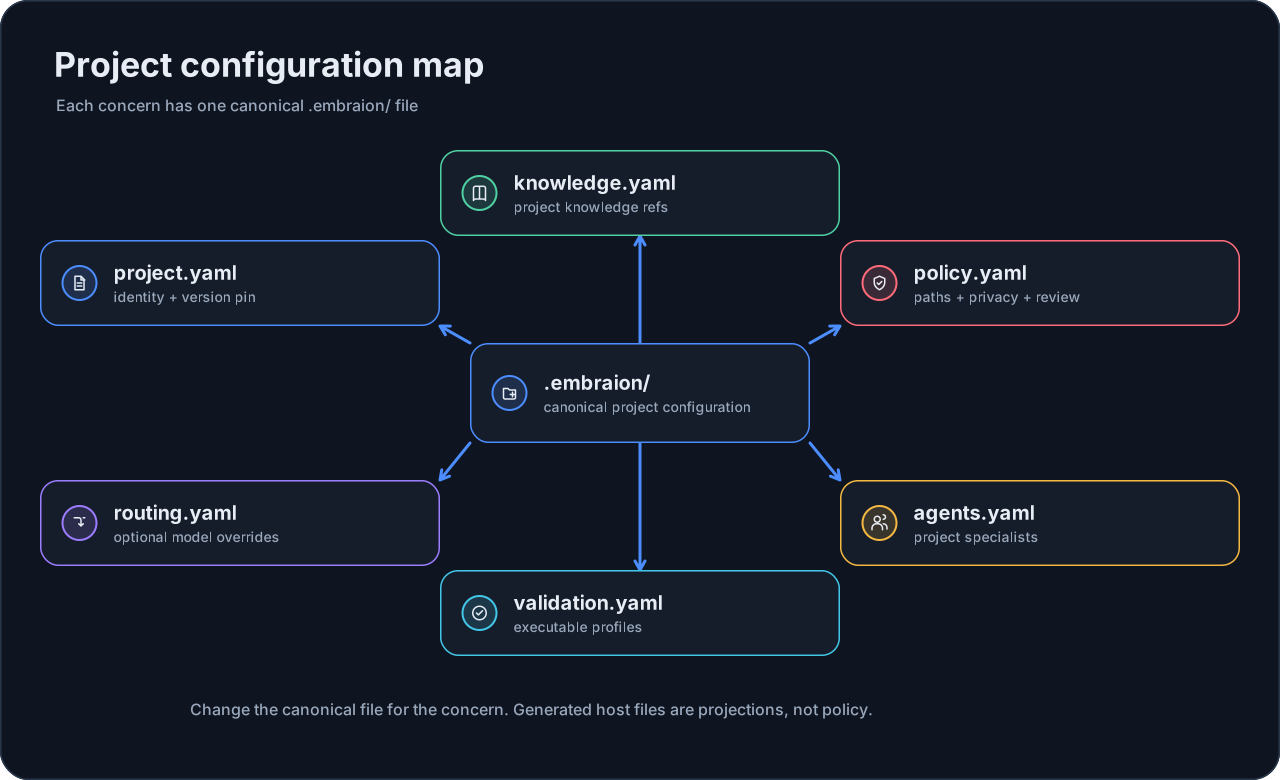
Project-owned layout
.embraion/
├── .gitignore
├── project.yaml
├── knowledge.yaml
├── policy.yaml
├── routing.yaml
├── validation.yaml
└── agents.yaml
Runtime state may later appear under .embraion/state/ and .embraion/cache/. Those directories are intentionally ignored by .embraion/.gitignore.
Ownership rule
The consuming repository owns its .embraion/ configuration and project/domain knowledge. Generated Codex, Copilot, Claude Code, and Portable files are projections of that canonical contract rather than a second place to express policy.
Project configuration may make local rules stricter, but it must not silently weaken reusable Core hard gates.
Recommended order
Do not configure everything at once. A normal project usually benefits from this order:
- Identity — confirm
project.yaml. - Knowledge — register project and architecture truth.
- Policy — classify source paths and choose privacy/review defaults.
- Validation — add the commands that actually prove changes work.
- Host projection — install the AI client(s) you use.
- Agents — add project specialists only when Core roles are not enough.
- Routing — leave host-default unless explicit model selection is useful.
- Enforcement — enable only after policy and validation are trustworthy.
Baseline configuration
project.yaml
framework:
  repository: GORYNED/EmbrAIon
  version: <pinned-version>

project:
  name: <project-name>

capabilities: {}
knowledge.yaml
{}
policy.yaml
sources:
  canonical: []
  protected: []
  generated: []
  external: []

review:
  substantial-required: true

privacy:
  default-class: PRIVATE

enforcement:
  enabled: false
  validation-profile: affected
  require-review: false
routing.yaml
overrides: {}
validation.yaml
profiles:
  fast: []
  affected: []
  full: []
agents.yaml
agents: []
You can ask your AI client to configure it
Manual YAML editing is optional. A useful request is:
Review this repository and configure its EmbrAIon project files. Keep project knowledge, policy, validation, agents, and routing in their canonical
.embraion/files. Preserve existing safety boundaries, do not invent model selectors, and explain every change before applying it.
Then inspect:
embraion doctor
embraion policy show
embraion validation list
embraion status