Engineering Model Deep Dive
This page is the precise engineering model behind the simpler Getting Started flow.
Projected guidance vs deterministic surfaces
| Surface | Meaning | Who executes it? |
|---|---|---|
| Generated agents / skills | Host-native instructions and procedures | AI host |
embraion route |
Resolve routing policy | EmbrAIon CLI |
embraion dispatch |
Build a bounded plan | EmbrAIon CLI |
| Host-native edits/search/tools | Actual engineering work | AI host |
embraion execute |
Bounded provider-neutral request | EmbrAIon runtime |
embraion validation run |
Real project commands + evidence | EmbrAIon CLI + project commands |
embraion enforcement check |
Protected-path / validation / review gate | EmbrAIon CLI |
| GitHub enforcement workflow | Merge-time CI surface | GitHub Actions |
Instruction delivery and deterministic enforcement are different mechanisms.
Core vs project ownership
| EmbrAIon Core owns | Project owns |
|---|---|
| generic roles and skills | architecture/domain knowledge |
| route/execution contracts | deployments and routing preferences |
| generic privacy/security mechanics | protected paths and project policy |
| validation/review mechanics | real validation commands |
| host projection behavior | project-specific agents |
| provider-neutral fallback/health | execution bindings and pricing sources |
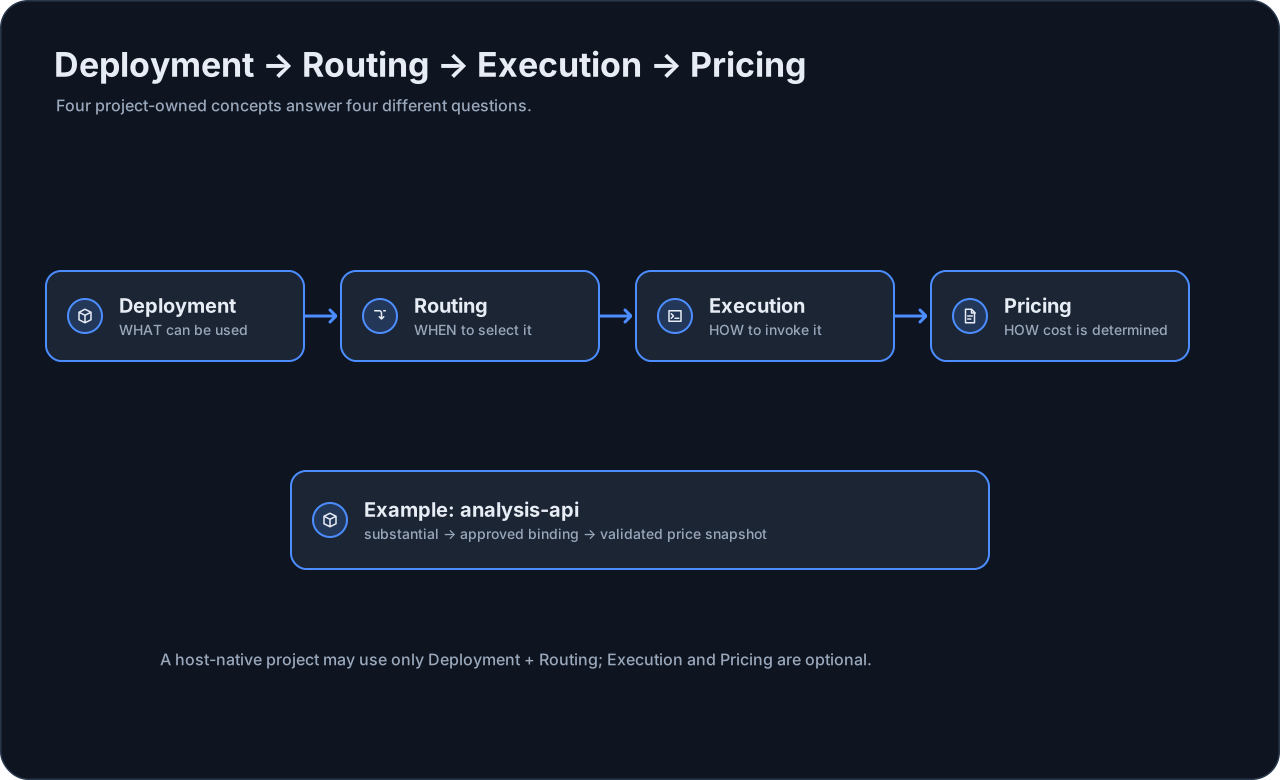
Deployments vs routing vs execution vs pricing
| Concept | Question | Project file |
|---|---|---|
| Deployment | What reusable concrete choice exists? | .embraion/deployments.yaml |
| Routing | When should a route/role select it? | .embraion/routing.yaml |
| Execution binding | How may it be invoked safely? | .embraion/execution.yaml |
| Pricing | How is cost interpreted/refreshed? | .embraion/pricing.yaml |
Route classes
| Route | Meaning |
|---|---|
bounded-read |
narrow read-only discovery/research |
bounded-write |
mechanical or tightly bounded writable work |
ordinary |
limited ordinary engineering |
substantial |
substantial engineering + standard review |
complex |
cross-domain, lifecycle, concurrency, or difficult review |
critical |
exceptional protected-decision risk such as persisted-data loss, recovery failure, systemic security exposure, or a breaking contract migration; size alone is not critical |
Route classes describe work and risk, not permanent model tiers.
Host-native vs provider-neutral execution
Host-native
The AI host owns reasoning and tools. EmbrAIon supplies project knowledge/policy/roles/routing and validation/review contracts.
Provider-neutral
embraion execute owns a bounded external/API attempt path through explicit project bindings. It can normalize failures/health and apply eligible fallback without widening the original request ceilings.
A routable deployment is not automatically executable; without a binding, the runtime can return handoff-required.
Evidence and acceptance
Transport completion is not project correctness. A project can still require deterministic validation, project-specific acceptance, independent review, and human merge approval.